August 13, 2023

Here we go again . . .

When I started this blog I was determined not to make it too political. The website was to remain – mostly anyway – an activist-free zone. But it’s hard sometimes. I’m not sure what it is about Tasmania but all too often its people tear themselves apart over controversial issues. So far, since I’ve lived here, there have been dams, forests, pulp mills and poker machines. The forestry issue has been ongoing for decades, and with no signs of a resolution. We nearly had one with the hard-fought forestry agreement that for an all- too-brief-time saw an end to the ’wars’ between timber workers and conservationists. The Liberals tore that up when they won government around 10 years ago. Now we’re back to where we were – a situation neither side wished for.


The latest controversy involves football. The AFL version, not soccer – which is of course the ball game of the moment, given the Women’s World Cup Championships, and Australia’s Matildas surpassing all expectations by making the semi-finals. And may the best team win.


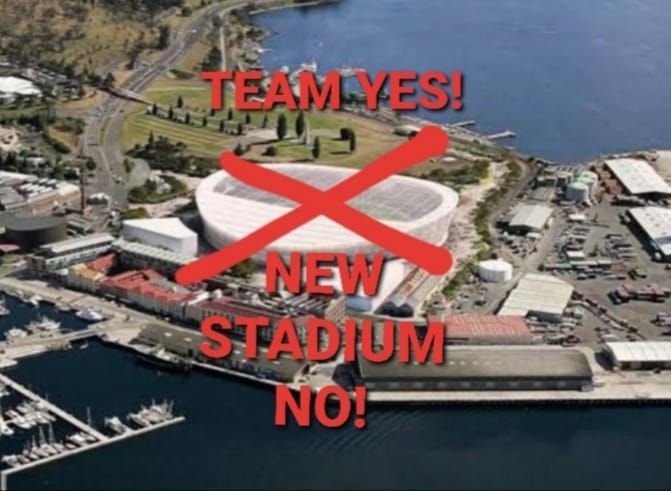
But soccer aside, what’s concentrating the minds of Tasmanians is whether the price of finally getting a licence to have a state team in the national AFL draw should depend on building a massive new stadium. The outgoing AFL boss insists it’s a condition of the licence. The premier apparently didn’t say boo to this rather high-handed demand despite most Tasmanians being outraged at the decision. And why not really when we already have two stadiums. One in the South and one in the North. Both have hosted AFL games for years – to audiences that haven’t always filled either stadium. Both stadiums have also successfully hosted other sporting events, as well as concerts.


So once again Tasmania is a state in conflict. The business case for a new stadium is extremely optimistic at best. More than one economist has picked a multitude of holes in it. And with so many other pressing social needs such as health, hospitals, housing and a homelessness crisis, requiring funding, building a stadium is considered the height of reckless extravagance by over half the population. The predictable if depressing result is sides being chosen, sleeves being rolled up, and preparing for another conflict to consume time and energy – for both those who are for it and those who are opposed.


A poem I wrote describes my opinion of the project. I entered it in the Independent Australia competition where I hoped it might at least get published – and raise awareness of the issue on a national platform – but I never believed for a second it could be a winner. But so it is: the July winner in the Fiction/Poetry category. At the No Stadium rally being organised later this month I’ve been invited to read it out.
So once again another poem I’ve written has resonated. I continue to be amazed – but if this one helps to change the hearts and minds of our government, and force a rethink on the terms of the contract, it’s done its job. No to a new stadium. Yes to a team.

Graphic designed by Marion Curtain

Share this post on socials
By Anne Layton-Bennett July 22, 2026
Attracting the interest of a publisher for this story of a community’s campaign to stop what would have been ‘the world’s fourth largest pulp mill’ being built was never going to be easy, but hoping the first of two 3-minute Literary Speed Dating pitch sessions will prompt at least one of the two publishers to request the full MSS. And preferably both of them. These twice-yearly Perfect Pitch sessions are offered to members of the Australian Society of Authors, and this is the first time I’ve taken advantage of them – mainly because of the need to have a completed MSS before doing so. Three minutes isn’t long to excite the interest of a publisher who is after stories in very specific genres, and who therefore needs to believe your MSS is worth investing the time needed to read it in full. I’m pretty certain I’ve excited the necessary interest, but given Jane will hear the pitches of many more optimistic and talented writers after my morning session today, there are no guarantees. That initial interest might well wane as the day goes on if other writers have written stories that sound far more intriguing – and marketable. One can never forget that aspect of publishing these days: will the book sell. I believe my story will – certainly in Tasmania it definitely will – but a wider Australian readership? That’s an unknown even if my mentor is convinced of the story’s universal appeal.  I’d certainly like to think I’ve caught the zeitgeist wave given the current widespread community unrest over AI data centres, that’s already prompting similar serious opposition, and for many of the same reasons the Tamar Valley’s community opposed the pulp mill. Environmental degradation, threats to public health, water usage – and water shortages in an era of escalating climate extremes – and the constant, relentless noise factor that’s associated with data centres, and AI data centres in particular. I’m crossing my fingers that the second pitch session will be equally positive, and that I could strike it lucky with both publishers requesting to see the full MSS. But I won’t get ahead of myself. I’ll just be keeping all fingers and toes firmly crossed for the next seven days.
Magni
By Anne Layton-Bennett June 14, 2026
It’s taken far too many months for this marvellous model to grace the dedicated desk space in my office. When Fiona comes to visit next she will be very surprised, and hopefully gratified, that her amazing creative talent is finally on display. We’ve known each other for a very long time, and during the insanely busy time when I was helping to run the flower farm, working part-time in a school library, doing a spot of journalism on the side, and fighting the proposed pulp mill that is the subject of the manuscript I’m hoping to get published, Fiona cleaned my house each week. There’s only so much a person can do after all, and it has to be said cleaning our house during those manic years was fairly low down on the list of my priorities. But Fiona is a woman of many talents and she certainly possesses one that I so don’t have: sewing and dressmaking. So over the years she’s also made a few garments based on the pattern of a favourite garment that I was particularly fond of, and she’s also done some clothing alterations for both of us. My skills with needles and thread are limited to sewing on buttons, and taking up hems on John’s too-long pairs of jeans. Anything else is beyond me. But this fabulous model is the pièce de résistance – along with the beautiful crocheted knee warmer she gave me last year. This was when winter was approaching and so determined was I to finish writing the book, I decided to get out of bed at the insane hour of 5am and get in a solid hour’s writing in before dog walking and the demands of the day took over. Fiona was also one of many Tasmanians who needed to be circumspect about her opinion of the pulp mill. It was a project that polarised people, including families and friendships. She was one of several who passed on snippets of useful information, but on the basis of anonymity so it couldn’t be sheeted home to her.  Needless to say Fiona will be one of those whose contribution will be acknowledged – when this book is finally accepted by a publisher.
By Anne Layton-Bennett June 8, 2026
Early lambing season a sign of changing seasons? Or economic reality?

Latest from my blog...